Quantus block reward explained: no halvings, just 1/50,000,000 of what is left
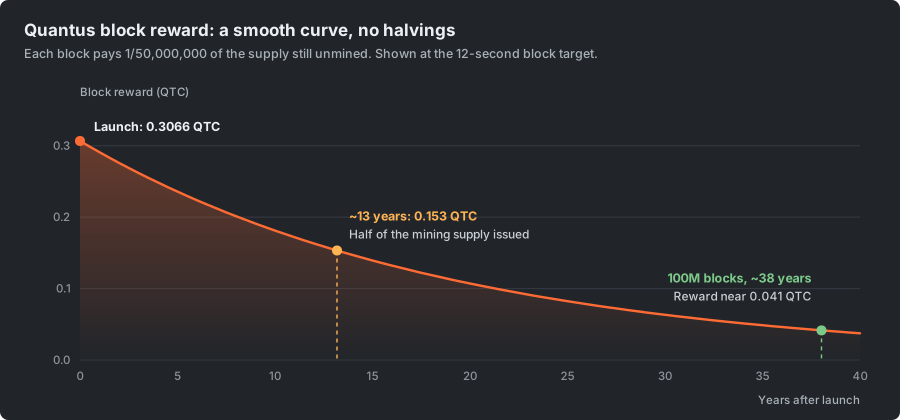
Most proof of work coins pay a fixed block reward and cut it in half on a schedule. Quantus (QTC) does neither. Every block pays one fifty millionth of the coins that have not been mined yet, so the reward falls a tiny amount with every block and never drops off a cliff. This post explains that rule, where the first reward of about 0.31 QTC comes from, why a block pays 0.30 or 0.31 QTC rather than an exact figure, and what a curve with no halvings means for anyone mining QTC.
The rule in one line
At the end of each block the Quantus runtime looks at how many coins could still be created: the 21,000,000 QTC maximum supply minus everything that already exists. It divides that number by 50,000,000, and the result is the block reward. Nothing in the formula looks at the block height or at a calendar. The only input is how much of the supply is still unmined, so the reward follows the supply rather than a timetable.
Where the first reward came from
Not all of the 21 million QTC is mined. 27% of the supply, 5,670,000 QTC, was created at genesis for investors, founders, the team and the company. That leaves 15,330,000 QTC, 73% of the supply, for miners. Divide 15,330,000 by 50,000,000 and you get 0.3066 QTC, which is the reward the very first mined block paid. Every block since has paid a little less, because every block removes its own reward from the amount still left.
Why there are no halvings
Taking the same fraction of what is left, block after block, gives a smooth curve that falls by the same percentage over any equal stretch of time. At the 12-second block target the network produces about 2.63 million blocks a year, so roughly 5.1% of the remaining mining supply is paid out each year, and the block reward is about 5.1% lower at the end of the year than at its start.
Two numbers make the curve easy to picture. Half of the 15.33 million QTC mining supply is paid out after about 34.7 million blocks, which is about 13 years at the target pace, and at that point the block reward is half of where it started, about 0.153 QTC. After 100 million blocks, about 38 years, the reward is near 0.041 QTC and about 86% of the mining supply has been issued. The reward keeps shrinking after that but never reaches zero on paper, which is why the curve approaches the 21 million cap rather than hitting it on a set date.
Those dates assume blocks arrive exactly on the 12-second target. The real pace depends on how quickly the difficulty adjustment follows changes in hashrate, so the calendar can drift a little either way. The rule itself does not drift: it is counted in coins left, not in time.
Why a block pays 0.30 or 0.31 QTC
One QTC is 10^12 base units, so the formula produces a long number such as 0.3066 QTC. The chain does not pay that exact figure. It rounds each block's payout down to a whole multiple of 0.01 QTC and carries the leftover into a later block. With the reward near 0.3066, the leftover adds up to an extra 0.01 QTC on roughly two blocks out of three, so you will see some blocks paying 0.30 QTC and others 0.31 QTC. Nothing is lost: over many blocks the payouts average out to the formula.
The transaction fees in a block go to the miner who finds it, on top of the subsidy. Quantus fees are small today, so the subsidy is almost the whole reward, but a busy block pays a little more than the curve alone.
What this means if you mine QTC
A halving forces miners to plan around one day: the morning after it, every rig earns half as many coins for the same work, and the hashrate that cannot survive that leaves at once. Quantus has no such day. At a steady share of the network hashrate, a rig earns about 5% fewer coins over a year from the curve, a change spread so thinly that no single week stands out.
That moves the attention to the things that change faster. Network difficulty, the QTC price and your own power cost will each move your earnings more in a month than the emission curve does in a year. The emission is the slow, predictable part of the sum, which is the part you can stop worrying about.
There is also no developer tax on mining rewards: the subsidy and the fees of each block go to the miner, or to the pool that splits them among its miners.
Checking the numbers yourself
Every figure here can be recomputed with a calculator: 15,330,000 divided by 50,000,000 is the first reward; 2,629,800 blocks a year divided by 50,000,000 gives the yearly rate; the natural logarithm of 2 times 50,000,000 is the number of blocks to the halfway point. The maximum supply, the 50,000,000 divisor and the 0.01 QTC rounding step are constants in the Quantus runtime, published on GitHub by the Quantus Network project, and the genesis split is the project's own published allocation.
If you want to see what the curve means for your own hardware today, the Quantus pool site has a mining calculator that reads the live reward and network difficulty, and the coin's page there draws the full emission chart. Pool and solo mining both run on the same servers, with hourly payouts in QTC.