








Parano1d (NOID) mining guide: rewards, pauses, orphans
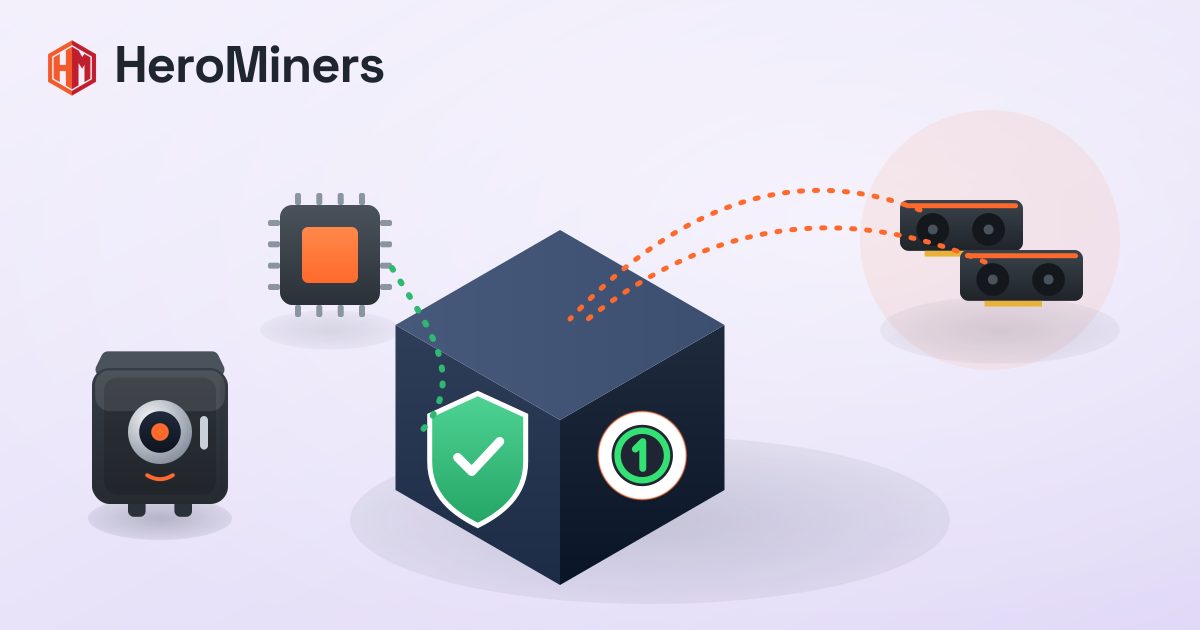
Parano1d (NOID) is a young proof of work coin with one unusual rule. A block is proven before anyone hashes it. That rule explains most of what a new NOID miner notices: short pauses, a reward smaller than the headline figure, and blocks that can still be replaced.
This guide explains each of those in plain words. Every figure comes from the Parano1d documentation, its code and its release notes, read on 6 November 2026.
Parano1d mining in short
- Parano1d launched on 21 August 2026. Its proof of work is called Poseidon2b.
- A full node builds a proof of the whole block on its CPU first. Only then can miners search for a nonce.
- So a miner can wait a few seconds after each new block. That pause is normal.
- The block reward is 16 NOID, and the miner gets 90% of it: 14.4 NOID.
- The reward steps down about once a year, from 16 NOID to a permanent 1 NOID.
- A block is final once 18 more blocks sit on top of it.
- GPUs do most of the nonce search today. A CPU still builds every block proof.
Why does a Parano1d miner pause after each new block?
On most coins, a pool hands out new work the moment a block arrives. Parano1d adds a step in front. The node must build a proof of the next block, called a HistoryStep, before any nonce search can start.
The proof covers everything in the block except the nonce. It checks the parent block, the transactions and the new state of every balance. A nonce is the number a miner changes on each guess, so the proof can be made once and reused for every guess.
The docs say the same thing in one line: the node "prepares a complete proof before returning a template". A template is the block a miner works on. Until the proof is done, there is no new template, so there is no new job.
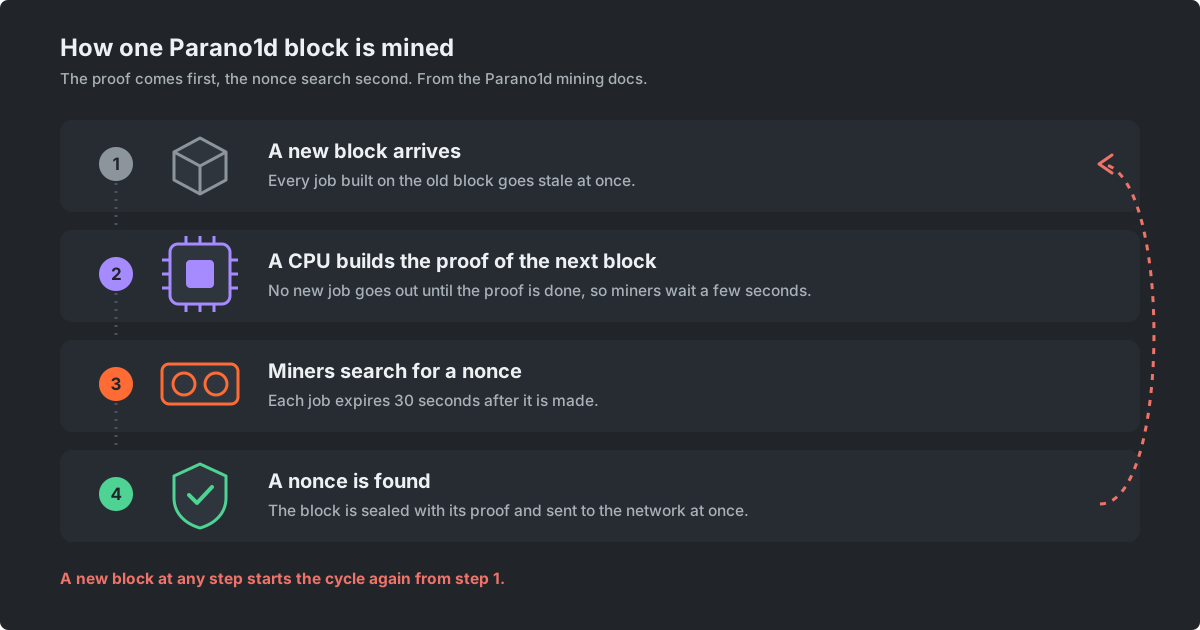
Three rules from the mining docs shape what a miner sees:
- A job expires 30 seconds after it is made.
- A job goes stale at once when a competing block is accepted.
- A node waits rather than mines when it is out of sync or has no trusted peer.
So a short gap after each block is the network working as designed. Your miner is not broken. A long gap with no jobs at all is different: then check your connection and your miner log.
How long the proof takes depends on the CPU behind it. The Parano1d team measured 18.7 to 32.6 seconds for an empty block on a laptop processor. Faster machines finish in a few seconds.
Why do you get 14.4 NOID and not 16?
Since block 210,537 each block creates 16 NOID. The economics page splits that subsidy three ways until block 3,223,778:
- 90% to the miner: 14.4 NOID per block.
- 5% to the O(1) Network Fund.
- 5% to Parano1d Lab.
The two 5% shares are not paid in each block. They are paid together every 2,880 blocks, which is about once a day. Each fund gets 2,304 NOID per full interval at the 16 NOID tier.
So a pool that shows 14.4 NOID per block is right. A block reward is the subsidy plus fees, and fees on NOID are still small next to the subsidy.
The NOID reward schedule
The reward falls in nine tiers, one every 1,051,200 blocks. At the 30 second target that is 365 days, so each date below is an estimate. Real dates follow how fast blocks arrive.
| Tier | From block | Subsidy | Miner gets | About when |
|---|---|---|---|---|
| 0 | 210,537 | 16 NOID | 14.4 NOID | October 2026 |
| 1 | 1,261,737 | 11.30 NOID | 10.17 NOID | October 2027 |
| 2 | 2,312,937 | 8 NOID | 7.2 NOID, then 8 NOID | October 2028 |
| 3 | 3,364,137 | 5.65 NOID | 5.65 NOID | October 2029 |
| 4 | 4,415,337 | 4 NOID | 4 NOID | October 2030 |
| 5 | 5,466,537 | 2.83 NOID | 2.83 NOID | October 2031 |
| 6 | 6,517,737 | 2 NOID | 2 NOID | October 2032 |
| 7 | 7,568,937 | 1.41 NOID | 1.41 NOID | October 2033 |
| 8 | 8,620,137 | 1 NOID, forever | 1 NOID | October 2034 |
This schedule replaced the first one at the v2 fork. Before it, the reward started at 50 NOID and halved when the network's state filled up. The v2 notes call that timing unpredictable, so the reward now follows block height alone.
What changed in Parano1d's first forks?
Parano1d is under three months old, and it has already changed its rules several times. Each change was a hard fork, so every node had to upgrade before a set block.
| Release | Active from | What changed for miners |
|---|---|---|
| v1.0.0 | Genesis, 21 August 2026 | Launch: 20 second blocks, a 50 NOID start reward and no premine |
| v1.1.0 | Block 95,125 | A fix to the difficulty formula |
| v2.0.1 | Block 210,537, 11 October 2026 | 30 second blocks, the yearly reward schedule and the 90/5/5 split; difficulty now comes from the parent block |
| v2.0.3, v2.0.4 | October 2026 | Fixes for database growth and lower CPU use |
| v2.1.0 | Block 279,370 | Native tokens, a DEX and NFTs; proof of work and block time unchanged |
The difficulty change in v2.0.1 matters for miners. Before it, a block could gain an edge in a same-height race by choosing its own timestamp. Now each block reads its difficulty from its parent, so two rival blocks carry the same target.
The lesson for anyone running a node is simple. Watch the release page and upgrade before each fork block. A node left on old rules follows a dead chain.
Orphan blocks, and when a block is final
An orphan block is a valid block that loses its place in the chain. On Parano1d this happens when two miners find a block at the same height at nearly the same time.
From v2, two blocks on the same parent carry the same target, so they hold the same work. The node then keeps the block with the smaller block id. A block id is a hash, so neither side can choose to win: each rival has about an even chance.
The 30 second block time makes these races more common than on slow coins. Public pool stats read on 6 November 2026 showed orphan rates from under 2% to about 12%, measured over different windows.
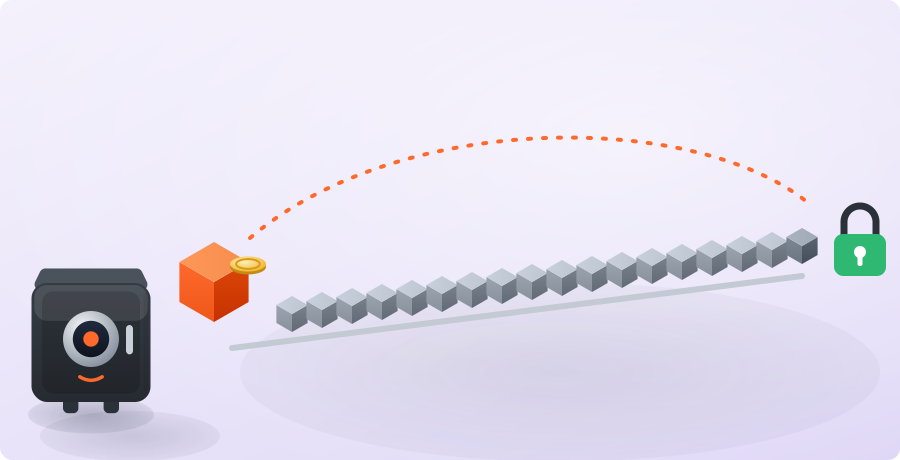
A block becomes final once 18 more blocks are built on it. Before that, a reorganisation of up to 17 blocks can still replace it. That is why a pool lists a new block as unconfirmed for a while. Our guide to pool luck and orphan blocks explains how a pool shares out that risk.
Should you mine Parano1d with a CPU or a GPU?
Parano1d was designed around CPUs. The docs ask for SSE4.1 and PCLMULQDQ on an x86 processor, or NEON and PMULL on ARM. Both are found on almost any desktop CPU from the last decade.
But the nonce search is a plain hash, and graphics cards are very good at plain hashes. GPU miners added Parano1d soon after launch, and today they do most of the work. The network ran at about 1.1 TH/s on 6 November 2026.
Your share of the blocks is your hashrate divided by the network's. Here is a worked example, not a benchmark:
- A rig of 1 GH/s against a network of 1,110 GH/s holds about 0.09% of it.
- The network makes about 2,880 blocks a day.
- So the rig finds about 2.6 blocks a day on average.
- At 14.4 NOID each, that is about 37 NOID a day, before fees and luck.
Measure your own device, then run the same sum. Our GPU, CPU and ASIC guide explains why one kind of chip pulls ahead on a given algorithm.
Solo mining NOID: a pool's solo port or your own node?
There are two ways to keep a whole block for yourself. They differ in who builds the proof and who holds the block until it pays.
| What differs | Solo on a pool | Your own node |
|---|---|---|
| Who builds the block proof | The pool's node | Your CPU |
| Who the block pays first | The pool, which then credits you | Your own o1 address |
| Fee | The pool's solo fee | None |
| What you run | A miner only | A full node, kept upgraded, plus a miner |
| Risk while the node waits for peers | Carried by the pool | Carried by you |
Your own node has no fee, but it is real work. It must stay in sync, upgrade before every fork and keep the CPU free to build proofs. The docs advise leaving CPU threads for the proof, because proof and hashing share one thread budget.
A pool's solo port is simpler: you run only a miner. Read our solo mining guide before you choose, because solo pays in long gaps rather than every day.
Which programs mine Parano1d?
Parano1d's own site lists more than a dozen mining programs. Their developer fees run from 0% to 5%, and two of them changed in the last weeks. These are the figures each program states itself:
| Program | Developer fee | Hardware for NOID |
|---|---|---|
| Parano1d Core | None stated | CPU |
| Suprminer | 0% | NVIDIA |
| INVminer | 1% | NVIDIA |
| SRBMiner-MULTI | 2% | NVIDIA and AMD |
| ForgeMiner | 2% | NVIDIA and AMD |
| GB Parano1d Miner | 2% | NVIDIA |
| PeakMiner | 2% | NVIDIA |
| Fl4shMiner | 3% | NVIDIA |
| NTMminer | 3% | CPU and NVIDIA |
| NOID GPU Miner for AMD | 5% | AMD |
A lower fee is not the whole story. A miner with a 2% developer fee that hashes 5% faster earns more than a 0% miner on the same card. Run each one for a full day and compare what your dashboard counts.
What to do before you start
- Create an o1 address in the official Parano1d wallet.
- Pick a miner from the table above and read its own fee page.
- Expect a short pause after each block. It is the proof being built.
- Count 14.4 NOID per block in your sums, not 16.
- If you run a node, upgrade before every fork block.
Frequently asked questions
Is a pause after each block a problem with my miner?
No. On Parano1d a node must prove each new block before it can hand out work. A gap of a few seconds after a block is normal. A gap that never ends means the miner has lost its connection.
Why does my pool show 14.4 NOID per block?
Each block creates 16 NOID, and 90% of it goes to the miner until block 3,223,778. The other 10% goes to two funds, paid about once a day.
When does the NOID block reward drop?
The first step, from 16 to 11.30 NOID, comes at block 1,261,737. At the 30 second target that is about October 2027.
How many confirmations make a NOID block final?
A block is final once 18 more blocks are built on it. Until then a reorganisation of up to 17 blocks can replace it.
Can I still mine Parano1d with a CPU?
Yes, and a CPU builds every block proof. For the nonce search, GPUs are much faster today, so compare your hashrate with the network before you spend power on it.