








Pearl FP8 fork explained: which GPUs keep mining
Pearl (PRL) is getting ready for its biggest change since launch. A proposal called PIP-3 moves Pearl mining from integer math to FP8. FP8 is the 8-bit floating point format that modern AI models run in.
The change is a hard fork, so every node has to upgrade. As written today, it also shortens the list of graphics cards that can mine.
This post explains what changes and why the hardware list narrows. It shows which cards are affected and what to do while no fork date exists.
The short version
- Pearl mining moves from integer math (INT7) to 8-bit floating point (FP8), the number format AI models run in.
- As drafted, only NVIDIA Hopper and Blackwell GPUs can mine after the fork. GeForce RTX 40, RTX 30 and RTX 20 cards cannot, and neither can any AMD or Intel GPU.
- No fork block is set. The latest Pearl release, v1.5.5 from 28 October 2026, contains no FP8 code.
- Until a release names a fork block, nothing changes. Keep mining as you do today.
What Pearl miners compute today
Pearl uses Proof of Useful Work (PoUW). Instead of hashing random numbers, a miner does work that is useful outside the chain. Here that work is matrix multiplication, the step AI training and inference spend most of their time on.
Random noise is added to the matrices so the result cannot be guessed. The product is cut into small blocks called tiles. Each tile becomes a number that works like a lottery ticket.
A ticket below the pool's target counts as a share. A ticket below the much harder network target is a block. A zero-knowledge proof, a short proof that the math was done right, lets every node check the work cheaply.
Today the matrix values are 8-bit integers with one bit of headroom. The specification calls this INT7. The products add up into 32-bit integers (INT32).
Integer math gives the same answer on every chip. That is one reason Pearl can be mined today on NVIDIA RTX 20 series and newer cards. Depending on the miner, it also runs on AMD and Intel GPUs.
What PIP-3 changes
PIP-3 is titled FP PoUW Certificates. The Pearl team published it on 30 July 2026 with the status Draft. It replaces the integer scheme with a floating point one.
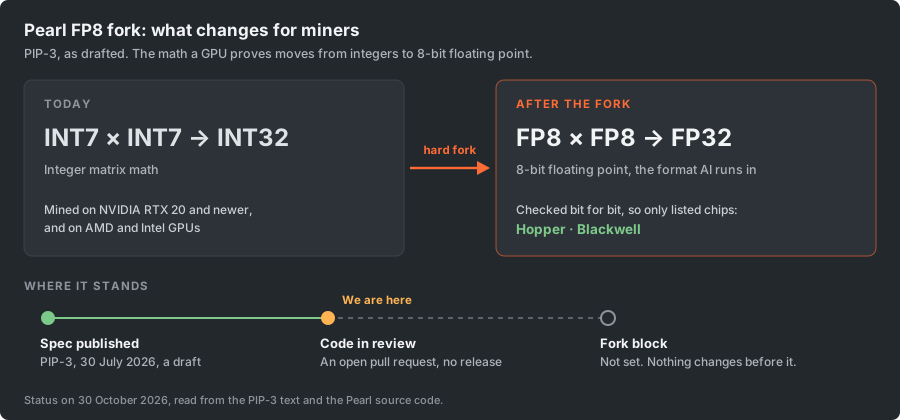
FP8 is a number that fits in 8 bits. Unlike an integer, it can also hold fractions. PIP-3 uses the E4M3 layout: one sign bit, four exponent bits and three mantissa bits.
The exponent bits set the size of the number, and the mantissa bits set its precision. The largest E4M3 value is 448. The products add up in 32-bit floating point (FP32).
Each row of a matrix also gets its own scale factor. That keeps its numbers inside the small FP8 range.
| What changes | Today | After the FP8 fork, as drafted |
|---|---|---|
| Number format | INT7, an 8-bit integer | FP8, the E4M3 layout |
| Products add up in | INT32, a 32-bit integer | FP32, 32-bit floating point |
| Same answer on every chip | Yes | No, only within one chip family |
| GPUs that can mine | NVIDIA RTX 20 and newer; AMD and Intel, depending on the miner | NVIDIA Hopper and Blackwell only |
The proposal gives usefulness as the reason. Almost all AI models are floating point by nature. Real inference already multiplies in FP8 and keeps the results in FP32.
A proof built on that same step can ride along with real model work. The proposal calls this an almost perfect two for one.
The reference miner on the development branch shows the idea in practice. It is a plugin for the vLLM model server, and it mines while the GPU serves an AI model.
The proposal is open about the cost. Floating point results are not bit-identical to the ideal answer, so the output is slightly lossy. The team reports no noticeable change in accuracy on the models it tested.
Floating point results also differ between chip families. That leads to the part that matters most to miners.
Why the GPU list gets shorter
Two GPU families can multiply the same FP8 matrices and still differ in the last bit. Each family adds up and rounds the numbers in its own way.
For Pearl that is a real problem, because the network cannot accept a result that is merely close. The proposal explains why. Any tolerance in the check would let a miner nudge the output and collect extra lottery tickets for no extra work.
So the check must repeat the miner's math exactly.
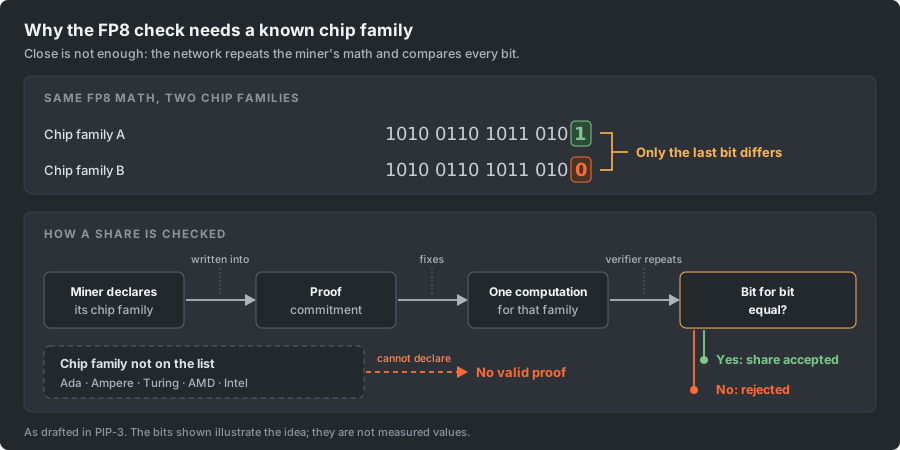
To make that possible, a miner declares its chip family up front. The family is written into the commitment that every proof is built on. The miner and the verifier then follow one fixed computation for that family.
Only families on a whitelist can be declared, and PIP-3 lists two: Hopper and Blackwell. A card from any other family has no valid way to prove its work. That holds however fast the card is at FP8.
Which GPUs keep mining, and which do not
The reference miner on the development branch loads on the chips below. It refuses to load on anything else.
Not sure which family your card belongs to? NVIDIA's list of CUDA GPUs gives each card's compute capability. 9.0 is Hopper, 10.0 and higher is Blackwell, and 8.9 is Ada.
| GPU family | Example cards | After the fork, as drafted |
|---|---|---|
| Hopper | H100, H200 | Keeps mining |
| Blackwell | B200, RTX PRO 6000, GeForce RTX 50 series | Keeps mining |
| Ada | GeForce RTX 40 series, L40S | Stops at the fork block |
| Ampere | GeForce RTX 30 series, A100 | Stops at the fork block |
| Turing | GeForce RTX 20 series | Stops at the fork block |
| AMD and Intel | Every model | Stops at the fork block |
One caveat for GeForce RTX 50 owners. The reference miner's own notes say its tests run on a B200.
The same notes say one tile shape has no kernel yet on RTX 50 cards. So the layers only that shape can mine are left out. No published test shows FP8 mining on a GeForce RTX 50 card so far.
There is a separate issue with today's official miner on the main branch. It is built for Hopper chips only. Two open reports show it failing on RTX 50 cards: no kernel for RTX 50 and a GEMM failure on the RTX 5070.
Two things are not known yet. Nobody has published how much GPU memory the new scheme needs on a given card. Nobody can say yet whether today's mining programs will support it.
The draft requires every miner to follow the reference computation exactly. So any program that wants to mine after the fork has to match it bit for bit.
What is still open in the draft
PIP-3 is a draft, and the text says so in several places. These parts are still marked to be decided before the proposal moves to the next status:
- The compact format matrices may be stored in before they are converted to FP8.
- The statistical checks a winning tile has to pass.
- The test vectors and the published experiments.
- The link to the reference miner.
- The deployment plan.
The development code has also moved on from the text in places. For example, it already handles mixture of experts layers. That is the AI model design in which only part of the model runs for each input.
It also numbers the certificate version differently. That is normal for a draft. But it means details can still change, including which hardware is accepted.
When it happens
There is no date. A Pearl fork activates at a block height written into the node software. No mainnet height exists for this one.
In the code under review, the fork height is set only for the local test networks developers use. The latest Pearl release, v1.5.5 from 28 October 2026 contains no FP8 code at all. When a release sets a height, that number is the one to note.
Pearl has changed consensus several times before. Every one of those changes activated at a fixed block named in a release. A miner who knows the block number and updates before it loses nothing.
What to do now
- Keep mining. Your miner, settings and payouts work exactly as before until the fork block. Do not change anything because of a draft.
- Find your card's family in the table above, or by its compute capability on NVIDIA's list.
- On a Hopper or Blackwell card, plan to install a miner that supports the FP8 scheme before the fork block, once one exists.
- On any other card, keep mining Pearl until the fork block. Choose now which coin the card will mine afterwards. The best mining GPUs list and the mining calculator show what your card earns on other coins.
- Watch the Pearl releases page and the Pearl proposals repository for a fork height.
- On fork day, judge your miner by its accepted shares on the pool, not by the hashrate it prints. An outdated miner can report a healthy hashrate while none of its work counts.
Thinking of buying hardware for Pearl? Buy for what the network accepts today and for what the final version accepts. Do not buy for a draft that may still change.
Frequently asked questions
Will the RTX 4090 still mine Pearl after the FP8 fork?
Not as PIP-3 is written today. The RTX 4090 is an Ada card, and Ada is not on the draft's list of chip families. That is true even though it can do FP8 math in hardware. It keeps mining Pearl normally until the fork block.
Does the RTX 5090 keep mining Pearl?
As drafted, yes. The GeForce RTX 50 series is Blackwell, and the reference miner on the development branch loads on it. No published test shows FP8 mining on a GeForce RTX 50 card yet.
Can AMD or Intel GPUs mine Pearl after the fork?
Not as drafted. The draft accepts NVIDIA Hopper and Blackwell only. AMD and Intel cards can mine Pearl today, depending on the miner. They keep doing so until the fork block.
Why can a fast RTX 4090 not mine FP8 Pearl?
Speed is not the problem. Each chip family rounds floating point math slightly differently. The network must repeat the miner's result bit for bit. That needs one fixed, agreed computation per family, and the draft defines one for Hopper and Blackwell alone.
When is the Pearl FP8 fork?
No date or block height has been set. The latest release, v1.5.5 from 28 October 2026, contains no FP8 code. A height will be named in a release once one is chosen.
Do I need to do anything today?
No. Keep mining as you do now. Act once a release names a fork block. Update your miner if your card is Hopper or Blackwell, or move the card to another coin if it is not.
Where these facts come from
Every statement here can be checked. The scheme, its motivation, the hardware whitelist and the open items come from the text of PIP-3. It sits in the Pearl team's public proposals repository.
The GPU support comes from the reference miner on the FP8 development branch of the Pearl repository. That miner states the chips it loads on.
The activation status comes from the network parameters in the same code. There, the FP8 fork height is set only for the test networks. It also comes from the latest release.
Where the sources say nothing, such as memory needs or support in other miners, this post says so. It does not guess.