







Quantus (QTC) mining pools: how to choose one
Quantus (QTC) is a young proof of work coin, and many pools already mine it. MiningPoolStats listed more than 30 of them on 4 November 2026. This guide covers what is special about mining Quantus, how the pools compare and how to start.
Quantus mining in short
- Quantus is mined on NVIDIA, AMD and Intel GPUs. A CPU is only good for testing.
- The official quantus-miner cannot join a pool. A pool needs a stratum GPU miner such as SRBMiner-Multi.
- Blocks arrive about every 14 seconds, so a server close to your rigs matters.
- HeroMiners charges 1% for pool and solo mining and pays every hour.
- HeroMiners can pay your Quantus earnings in Bitcoin or Monero, straight to your own address.
What makes Quantus different to mine
Quantus signs every transaction with ML-DSA, the NIST standard for post-quantum signatures. A signature is about 4,627 bytes, where a Bitcoin signature is about 65. That matters for wallets and block space, not for your graphics card.
You still mine to an ordinary address that starts with qz. The proof of work is called QPoW, and the Quantus docs say the name is branding. The real work grinds a 512-bit nonce through the Poseidon2 hash.
Which miner works on a Quantus pool
The project's own quantus-miner does not log in to a pool. It talks to a single Quantus node over a private QUIC link. It is a tool for solo mining with your own node.
A pool needs a GPU miner that speaks stratum. Our guide lists SRBMiner-Multi, BzMiner, PeakMiner, WildRig NG and ForgeMiner, each with a 2% developer fee on the check date. To compare cards, see our best mining GPUs.
Why Quantus blocks average about 14 seconds, not 12
The target is one block every 12 seconds, yet blocks arrive slower. The difficulty rule explains why. Quantus adjusts difficulty after every block, much like Ethereum's Homestead formula:
- A gap under 10 seconds raises the difficulty by 1/2048.
- A gap of 10 to 20 seconds changes nothing.
- Each further 10 seconds lowers it by another 1/2048.
Blocks arrive at random, so many gaps are short and a few are long. The raises and the cuts only cancel at an average gap of about 14.4 seconds. That is 10 seconds divided by the natural logarithm of 2.
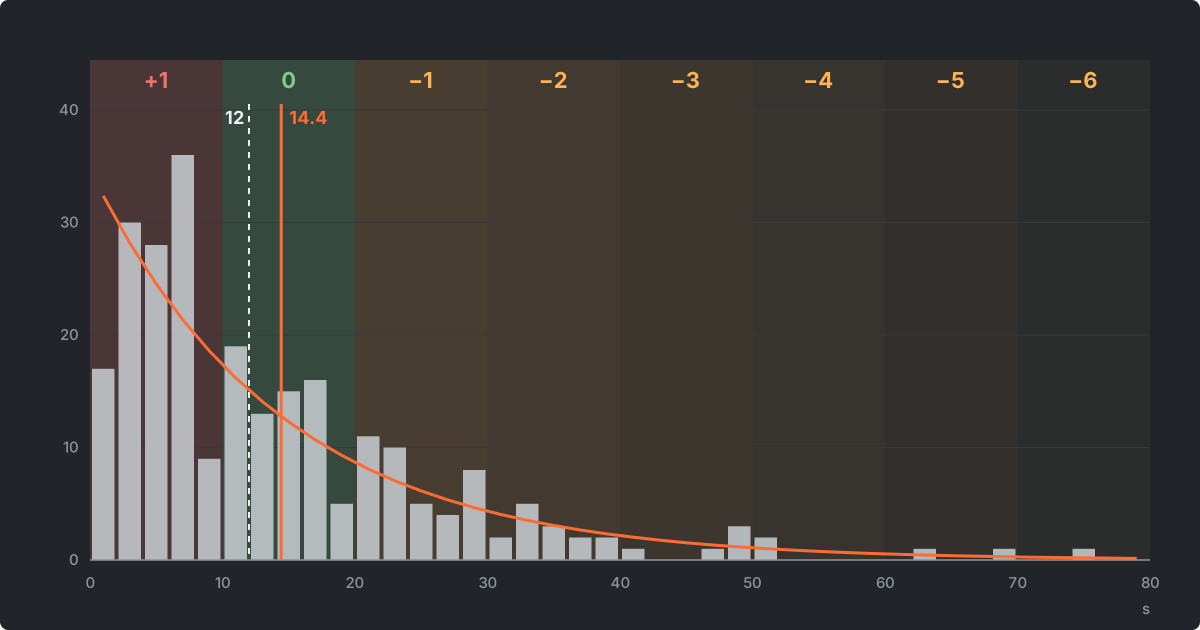
Our Quantus site showed an average block time of 14.3 seconds on the check date. So the network mints about 6,000 blocks a day, not 7,200.
Two sites can also show network hashrates about a fifth apart. One divides the difficulty by the 12-second target, the other by the measured gap. Neither changes what your rig earns. Why the reward shrinks without halvings is in our Quantus block reward post.
HeroMiners and five other Quantus pools, feature by feature
The table puts HeroMiners next to five of the best-known Quantus pools. Green means the pool has the feature, yellow means part of it, and red means its Quantus page did not show it. Every mark also carries its word, so it reads without colour.
| Feature | HeroMiners | Kryptex Pool | LuckyPool | F2Pool | 2Miners | K1Pool |
|---|---|---|---|---|---|---|
| Fee | 1% pool, 1% solo | 3% pool, 3% solo | 1% pool, 1% solo | 1% pool | 1% pool, 1.5% solo | 1% pool |
| Solo mining | Yes | Yes | Yes | No | Partial | No |
| Payout in BTC or XMR to your own address | Yes | Partial | No | No | No | No |
| Alerts on Discord, Telegram, Web Push and ntfy | Yes | Partial | No | Partial | Partial | Partial |
| Server regions | Yes | Limited | Yes | Limited | Limited | Limited |
| Regional proxies | Yes | No | No | No | No | No |
| Mirror domain for blocked countries | Yes | No | Yes | No | No | No |
| TCP and TLS on the same port | Yes | No | No | No | No | Yes |
| Automatic region failover | Yes | No | No | No | No | No |
| Site languages | Yes | Partial | Partial | Partial | Partial | Partial |
| Live worker stream | Yes | No | No | No | No | No |
| Worker warnings | Yes | Yes | No | No | No | No |
| Support tab on the dashboard | Yes | No | No | No | No | No |
| Notification history | Yes | No | No | No | No | No |
Checked on each pool's own site on 5 November 2026. Payout in another coin is green only when both BTC and XMR go to your own address. Alerts are green only with all four of Discord, Telegram, Web Push and ntfy.
How to choose a Quantus pool
- Start with the payout scheme. PROP and PPLNS both split the blocks a pool finds, and PPLNS pays less to rigs that hop in and out. Solo pays you the whole block, but only when you find one.
- Check that your miner works with the pool. Count its developer fee next to the pool fee, since 2% is common on Quantus.
- Pick a server close to your rigs. Almost half of all Quantus blocks come within 10 seconds, so a slow link means more stale shares.
- Compare the minimum payout with what your rig earns in a day. Then decide whether you want QTC or another coin.
What HeroMiners offers on Quantus
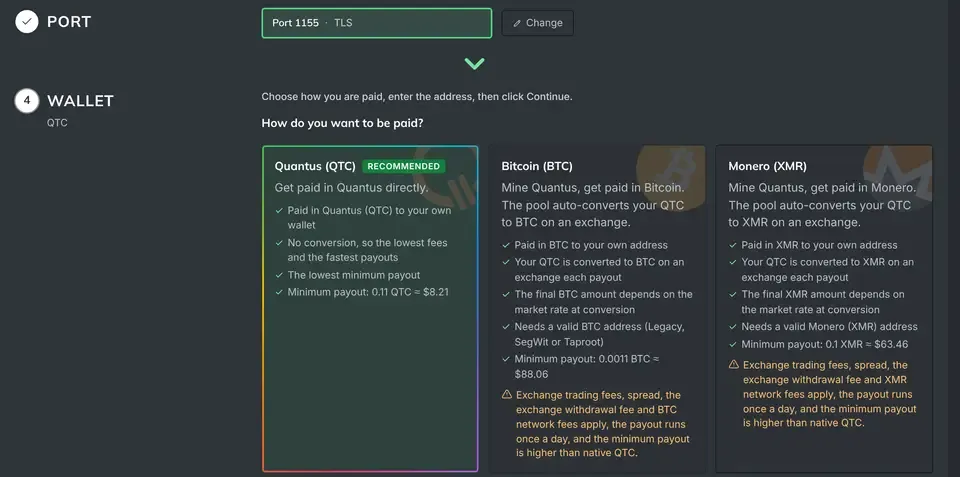
HeroMiners can pay your Quantus earnings in Monero (XMR) or Bitcoin (BTC). The pool converts them on an exchange once a day and sends them to your own address, with no account. No other pool in the table offered Monero payouts on its Quantus page.
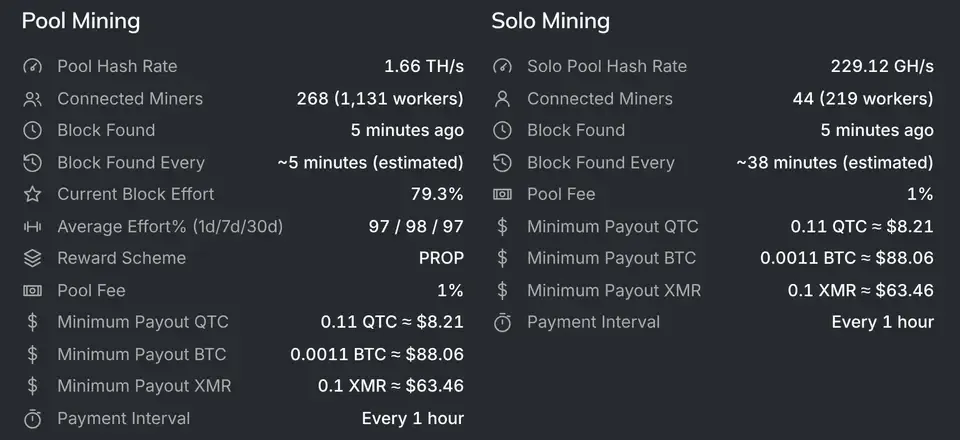
A QTC payout goes out every hour from 0.11 QTC. The BTC and XMR minimums are 0.0011 BTC and 0.1 XMR, and exchange fees apply to those.
Your dashboard can alert you on Discord, Telegram, Web Push or ntfy. It covers blocks, payouts, hashrate drops and offline workers. The whole site, help centre included, is in 37 languages.
Pool and solo mining share 11 regions: Germany, France, Finland, Russia, three US sites, Brazil, Hong Kong, Japan and Singapore. Each takes TCP or TLS on port 1155. For solo, add solo: in front of your address.
Both modes charged 1% on the check date, and the pool paid PROP. A block reward is credited once the block is 100 blocks deep, where the Quantus chain treats it as final. Rented hashpower the pool detects is moved to solo.
Several features in the table were ours alone on the check date. Every region runs its own proxy, and the guide picks the closest one. If a region goes down, its miners move to another region on their own.
The dashboard streams each worker live. It warns you about an outdated miner, a high reject rate or a closer server. It also keeps a history of every alert and has a Support tab for reaching us.
How to start mining Quantus on HeroMiners
- Open the guide at quantus.herominers.com/how-to-mine-quantus-qtc/. It tests every server from your browser.
- Pick your port type, payout coin, address, mode, miner and operating system. The guide builds a command to paste.
- If herominers.com is blocked where you live, the guide offers the gfwroute address and proxies instead.
- Check your earnings first with the Quantus mining calculator, or your solo odds with the solo mining calculator.
The live fee is always on quantus.herominers.com. To compare Quantus with every other coin we mine, open our hub calculator.
FAQ
Do I need the official quantus-miner to mine on a pool?
No. It connects to one node over QUIC and is meant for solo mining with your own node. Pools take stratum connections from GPU miners such as SRBMiner-Multi, BzMiner, PeakMiner, WildRig NG and ForgeMiner.
Can I mine Quantus with a CPU?
The node has a built-in CPU miner, which the project calls fine for testing. Mining is far faster on a GPU, and our guide builds GPU-only commands.
Do post-quantum signatures change how I mine?
No. They change how transactions are signed, not the proof of work. You mine and get paid to a normal qz address.
Can I mine Quantus solo on HeroMiners?
Yes. Use the same server and port with solo: in front of your address. You keep the whole block reward minus the solo fee.