








Pearl (PEARL) mining pools compared feature by feature
Pearl (PEARL) is mined on graphics cards, and most miners join a pool so their income arrives steadily. This guide covers what is different about mining Pearl, how six pools compare feature by feature, and how to start on HeroMiners.
HeroMiners writes the ticker as PEARL, while many exchanges and pools list it as PRL. Both name the same coin, and every main network address starts with prl1.
Pearl mining in short
- Pearl is mined on GPUs: NVIDIA RTX 20 series and newer, and, depending on the miner, older NVIDIA, AMD and Intel cards. There is no CPU or ASIC path.
- A block is due every 3 minutes 14 seconds. It paid about 2,159 PEARL on 18 November 2026.
- HeroMiners charges 1% for pool mining and 1% for solo mining, both on port 1200.
- Rather hold Bitcoin or Monero? HeroMiners sells your PEARL once a day and sends BTC or XMR to a wallet you own.
- A drafted fork called PIP-3 would leave only NVIDIA Hopper and Blackwell cards mining. It has no mainnet date yet.
What makes Pearl different to mine
Pearl runs on Proof of Useful Work. Your GPU does not hash random numbers. It multiplies large matrices, the same math that AI models spend most of their time on.
The idea comes from a 2025 paper on useful work from matrix multiplication, which the Pearl project links. Random noise is mixed into the matrices, so nobody can know the answer in advance.
The product is then cut into small tiles, and each tile becomes a ticket. A low enough ticket is a share. A far lower one is a block.
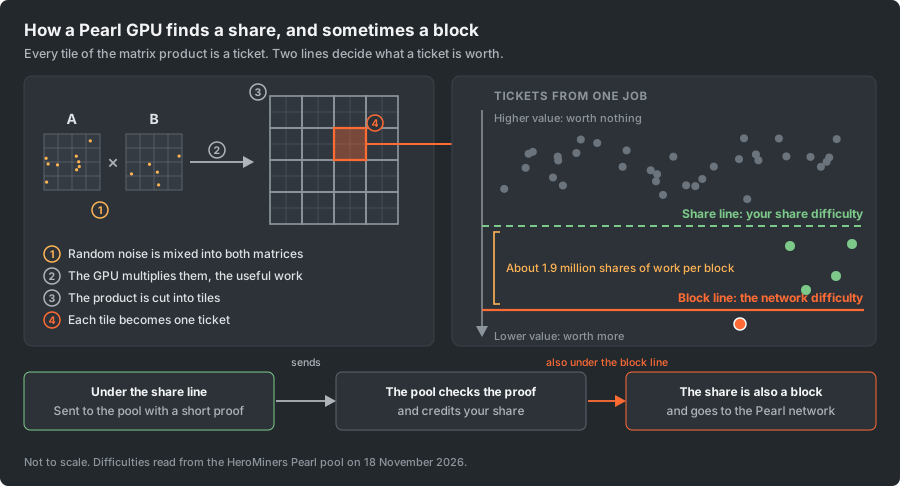
Each share carries a zero-knowledge proof, a short proof that the math was done right. HeroMiners checks that proof on every share before it credits you.
On 18 November 2026 a block needed about 1.9 million times the work of one share. That gap is why a pool pays more steadily than a single rig. Many rigs together find blocks often, while one rig alone may wait a long time.
Pearl in numbers
- Block target: 194 seconds, set in the Pearl node source.
- Supply: 2.1 billion PEARL in total, with no halvings. The reward falls a little with every block, and half of all coins are mined in the first four years.
- Block reward: about 2,159 PEARL at block 145,096, on 18 November 2026.
- Block gaps measured on our pool: the last 250 blocks averaged 201 seconds. Half came within 122 seconds, and about 1 in 12 took longer than 10 minutes.
- Maturity: a block's reward can be spent 100 blocks later, about 5 hours 23 minutes. A pool pays a block out after that.
Pearl has changed its mining rules several times since launch, and a pool that warns you early saves you rejected shares. Our post on why Pearl forked four times explains each change.
HeroMiners and five other Pearl pools, feature by feature
We hold HeroMiners up against five large pools that also run Pearl. A green mark means the pool has the feature, and yellow means it has part of it. Red means the pool's own Pearl page did not show it. Every mark carries its word as well, so colour is never needed.
| Feature | HeroMiners | Kryptex Pool | LuckyPool | F2Pool | 2Miners | K1Pool |
|---|---|---|---|---|---|---|
| Fee | 1% pool, 1% solo | 3% pool, 1% solo | 1% pool, 1% solo | 1% pool | 1% pool, 1.5% solo | 0% pool, 1% solo |
| Solo mining | Yes | Yes | Yes | No | Yes | Yes |
| Payout in BTC or XMR to your own address | Yes | Partial | No | No | Partial | No |
| Alerts on Discord, Telegram, Web Push and ntfy | Yes | Partial | No | Partial | Partial | Partial |
| Server regions | Yes | Yes | Yes | Limited | Limited | Limited |
| Regional proxies | Yes | No | No | No | No | No |
| Mirror domain for blocked countries | Yes | No | Yes | No | No | No |
| TCP and TLS on the same port | Yes | No | Yes | No | No | No |
| Automatic region failover | Yes | No | No | No | No | No |
| Site languages | Yes | Partial | Yes | Partial | Partial | Partial |
| Live worker stream | Yes | No | No | No | No | No |
| Worker warnings | Yes | Yes | No | No | No | No |
| Support tab on the dashboard | Yes | No | No | No | No | No |
| Notification history | Yes | No | No | No | No | No |
Checked on each pool's own Pearl page or api on 18 November 2026. A payout row is green only with both BTC and XMR sent to your own address. An alerts row is green only with all four channels.
How to choose a Pearl mining pool
- Pick a server near your rigs. Pearl blocks often come close together, and a share that arrives after a new block earns nothing. Our guide on choosing a server region shows how to test it.
- Read the fee beside the payout scheme. A scheme that pays a fixed rate per share usually costs more than one that pays from the blocks found.
- Decide which coin you want to hold. If you would sell your PEARL anyway, a payout in BTC or XMR saves you the trip to an exchange.
- Check what your mining program supports. The FP8 fork, if it ships as drafted, will need a new miner on Hopper and Blackwell cards.
Pool or solo is the other choice. In a pool, each block is split among every rig that sent shares. Solo pays the whole block to the rig that finds it, and nothing until then.
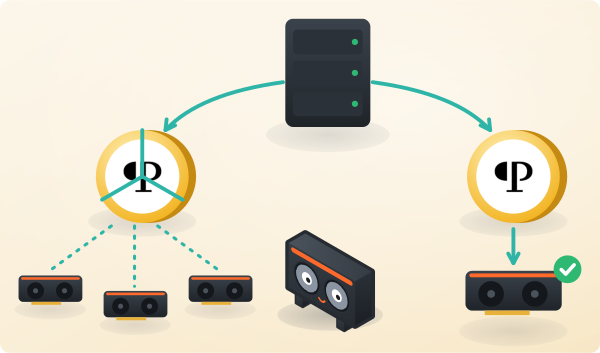
With about 445 blocks a day across the whole network, solo suits a large farm. The Pearl solo mining calculator shows how long a block may take at your hashrate.
Getting paid in Bitcoin or Monero for mining Pearl
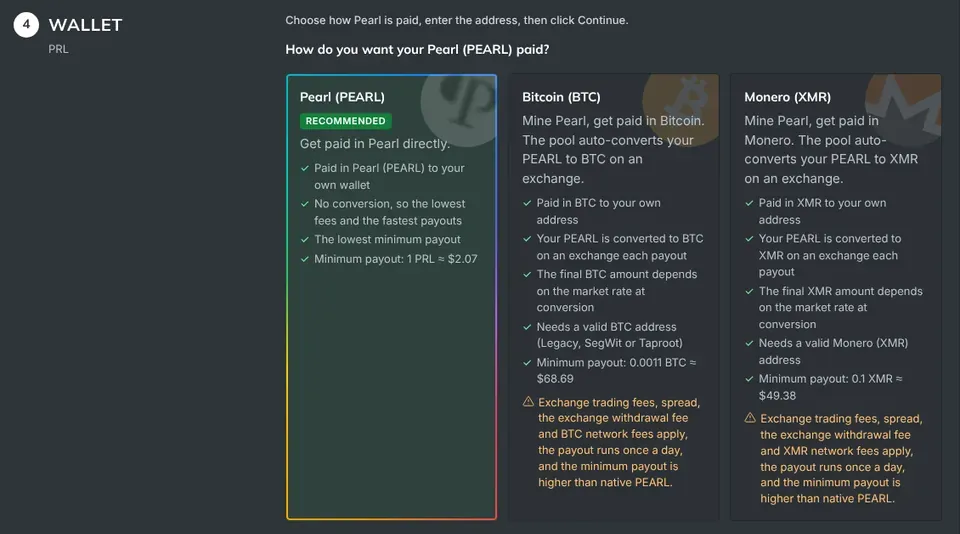
You mine Pearl either way, and the pool credits your balance in PEARL. The payout coin is your choice, and it decides how often money arrives.
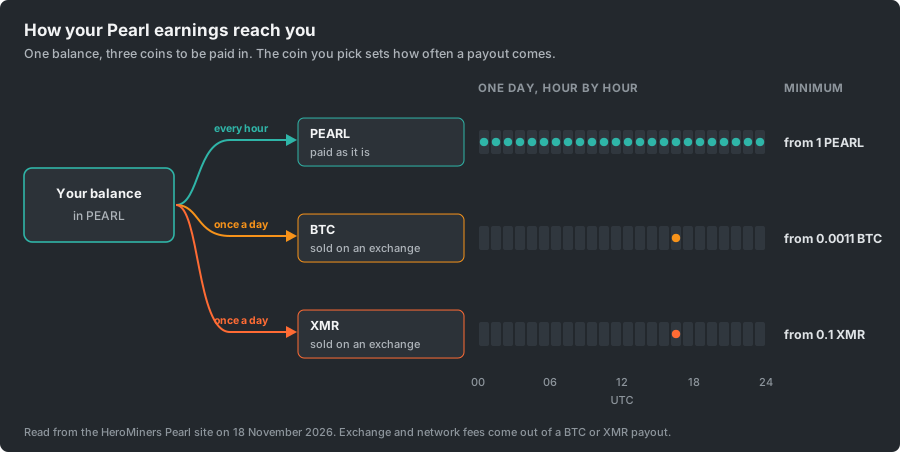
Plain PEARL is the cheapest choice: no conversion and the lowest minimum. BTC or XMR suits a miner who would sell anyway, and the coin lands in a wallet you control, with no account to open.
Servers, routes and alerts on HeroMiners
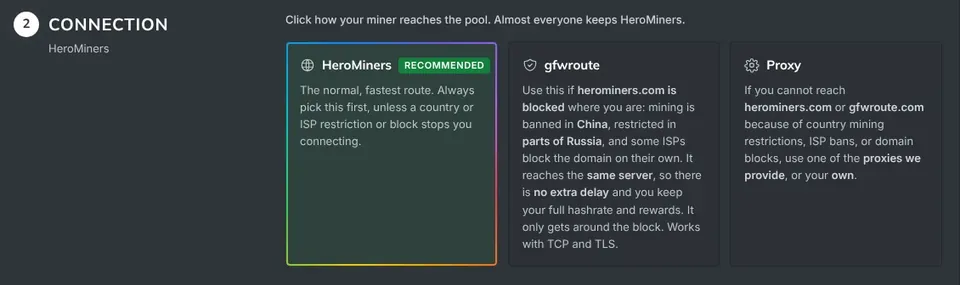
Pearl runs on 11 server regions: Germany, France, Finland, Russia, three in the USA, Brazil, Hong Kong, Japan and Singapore. Each one takes plain TCP and encrypted TLS on port 1200.
Where herominers.com is blocked, the same servers answer under gfwroute.com. Every region also has a proxy of its own. If a region goes down, its miners move to another region without a change on the rig.
Your dashboard can alert you on Discord, Telegram, Web Push or ntfy about blocks, payments and workers that stop. It keeps a history of every alert, streams each worker live, and flags an outdated miner or a high reject rate.
How to start mining Pearl on HeroMiners
- Get a Pearl wallet address. Main network addresses start with prl1.
- Open the Pearl mining guide. It tests every server from your browser and marks the closest.
- Choose the route, TLS or TCP, your payout coin, pool or solo, your miner and your system. The guide builds a command to paste, for SRBMiner-Multi, BzMiner, PeakMiner, WildRig NG or ForgeMiner.
- For solo, put solo: in front of your address. Nothing else changes.
- Once shares are accepted, enter your address on pearl.herominers.com to follow your workers.
Before you buy cards or power, try the Pearl mining calculator, or compare cards on our best mining GPUs page. To weigh Pearl against every other coin we mine, open the hub calculator.
The fee on the site is always the live one. If you are not sure your card will keep mining after the FP8 fork, read which GPUs keep mining Pearl.
Pearl mining pool FAQ
Is PEARL the same coin as PRL?
Yes. HeroMiners writes the ticker as PEARL, and many exchanges and pools write PRL. Both name one coin, and its main network addresses start with prl1.
Can I mine Pearl with a CPU?
No. Pearl work is matrix multiplication with a proof, and it is mined on GPUs. Our guide builds commands for graphics cards only.
Can I be paid in Bitcoin for mining Pearl?
Yes, on HeroMiners. Choose BTC or XMR in the guide and enter that address. Your PEARL is sold on an exchange once a day and the coin is sent to your own wallet.
How do I mine Pearl solo on HeroMiners?
Put solo: in front of your Pearl address and keep the same server and port 1200. A block you find pays its whole reward to you, minus the solo fee.
Will my GPU still mine Pearl after the FP8 fork?
Only NVIDIA Hopper and Blackwell cards, if PIP-3 ships as drafted. No mainnet date is set, so every card that mines Pearl today keeps mining until a release names the fork block.